-
Artificer

You learned the Craft, the Sacred Science, somewhere. Maybe in the workshops of Verbobonc, apprenticed to a Rock Gnome or in the laboratory of a Baklunish alchemist. You may have been taken in by an eccentric who claims to have worked in a secret laboratory in the Kron Hills, building weapons for a war yet to come. Alternatively, through your insatiable curiosity paired with your unsettling aptitude for making things explode,you may have discovered the magical craft of Artifice on your own.
You channel magic into clockworks and automata, molding mundane materials into arcane wonderworks. As you progress down the path of the Artificer, you will specialize into an alchemist, master of clockwork soldiers, or battlefield engineer. You are a builder of tick-tock minions, weapons of mass destruction, and gimmicks to dazzle children.
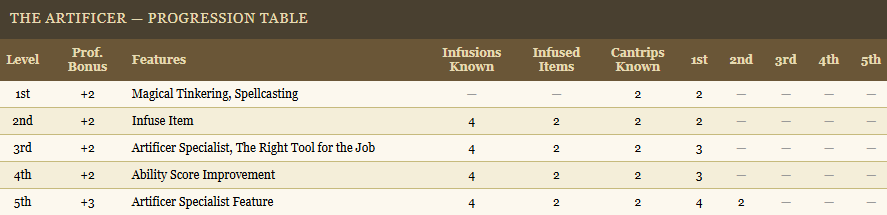
As an artificer, you gain the following class features.
Hit Points
Hit Dice: 1d8 per artificer level
Hit Points at 1st Level: 8 + your Constitution modifier
Hit Points at Higher Levels: 1d8 (or 5) + your Constitution modifier per artificer level after 1stProficiencies
Armor: Light armor, medium armor, shields
Weapons: Simple weapons
Tools: Thieves’ tools, tinker’s tools, one type of artisan’s tools of your choice
Saving Throws: Constitution, Intelligence
Skills: Choose two from Arcana, History, Investigation, Medicine, Nature, Perception, Sleight of HandEquipment
You start with the following equipment, in addition to the equipment granted by your background:
- any two simple weapons
- a light crossbow and 20 bolts
- (a) studded leather armor or (b) scale mail
- thieves’ tools and a dungeoneer’s pack
Alternatively, you may start with 5d4x10 starting gold
Optional Rule: Firearm Proficiency
The secrets of gunpowder weapons have been discovered in various corners of the D&D multiverse. If your Dungeon Master uses the rules on firearms in the Dungeon Master’s Guide and your artificer has been exposed to the operation of such weapons, your artificer is proficient with them.
At 1st level, you’ve learned how to invest a spark of magic into mundane objects. To use this ability, you must have thieves’ tools or artisan’s tools in hand. You then touch a Tiny nonmagical object as an action and give it one of the following magical properties of your choice:
- The object sheds bright light in a 5-foot radius and dim light for an additional 5 feet.
- Whenever tapped by a creature, the object emits a recorded message that can be heard up to 10 feet away. You utter the message when you bestow this property on the object, and the recording can be no more than 6 seconds long.
- The object continuously emits your choice of an odor or a nonverbal sound (wind, waves, chirping, or the like). The chosen phenomenon is perceivable up to 10 feet away.
- A static visual effect appears on one of the object’s surfaces. This effect can be a picture, up to 25 words of text, lines and shapes, or a mixture of these elements, as you like.
The chosen property lasts indefinitely. As an action, you can touch the object and end the property early.
You can bestow magic on multiple objects, touching one object each time you use this feature, though a single object can only bear one property at a time. The maximum number of objects you can affect with this feature at one time is equal to your Intelligence modifier (minimum of one object). If you try to exceed your maximum, the oldest property immediately ends, and then the new property applies.
-
Barbarian
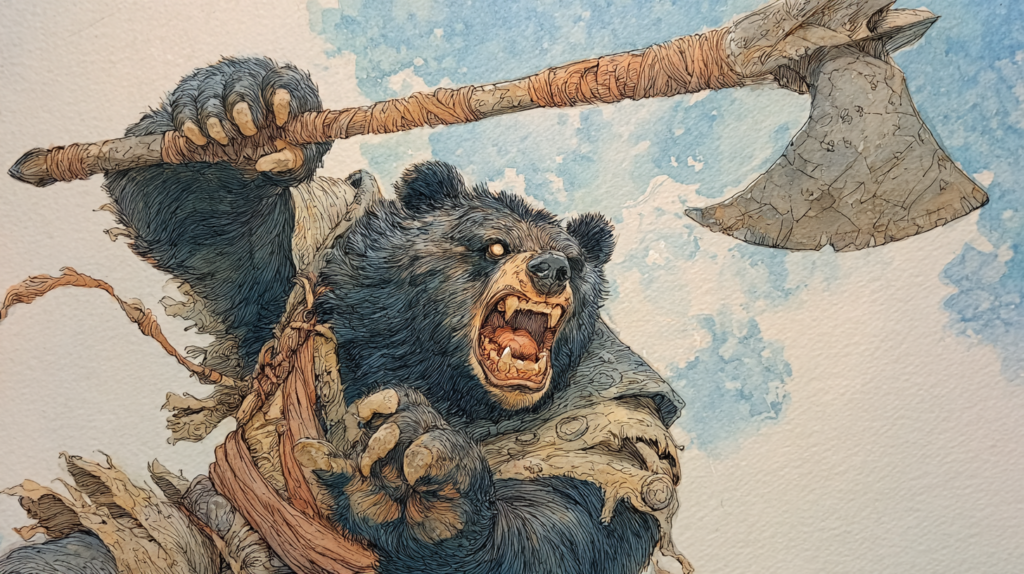
You come from wild country and wild people, and you are naturally toughened by your upbringing. Barbarians are found amongst all peoples and kingdoms of Elfmyst, but the most notorious are the bearfolk bezerkers of the North. You are often uncultured in the convoluted customs city-folk call “sophistication” or more bluntly “manners”, but you make do.
Your primal instincts let you tap into a deep internal well of anger, called rage, that sets you apart from others. This rage gives you the ability to shrug off blows that would fell others more well armored and strike with the might of the ancestors. Some barbarians learn to connect to the spirits of this world, championing them as a totem warrior. Others see their rage as a means to an end, letting it guide them in frenzy and mindless fury.
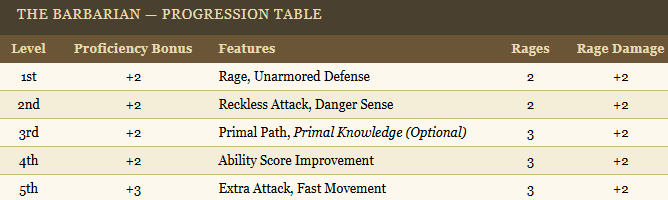
As a barbarian, you gain the following class features.
Hit Points
Hit Dice: 1d12 per barbarian level
Hit Points at 1st Level: 12 + your Constitution modifier
Hit Points at Higher Levels: 1d12 (or 7) + your Constitution modifier per barbarian level after 1stProficiencies
Armor: Light armor, medium armor, shields
Weapons: Simple weapons, martial weapons
Tools: None
Saving Throws: Strength, Constitution
Skills: Choose two from Animal Handling, Athletics, Intimidation, Nature, Perception, and SurvivalEquipment
You start with the following equipment, in addition to the equipment granted by your background:
- (a) a greataxe or (b) any martial melee weapon
- (a) two handaxes or (b) any simple weapon
- An explorer’s pack and four javelins
In battle, you fight with primal ferocity. On your turn, you can enter a rage as a bonus action.
While raging, you gain the following benefits if you aren’t wearing heavy armor:
- You have advantage on Strength checks and Strength saving throws.
- When you make a melee weapon attack using Strength, you gain a bonus to the damage roll that increases as you gain levels as a barbarian, as shown in the Rage Damage column of the Barbarian table.
- You have resistance to bludgeoning, piercing, and slashing damage.
If you are able to cast spells, you can’t cast them or concentrate on them while raging.
Your rage lasts for 1 minute. It ends early if you are knocked unconscious or if your turn ends and you haven’t attacked a hostile creature since your last turn or taken damage since then. You can also end your rage on your turn as a bonus action.
Once you have raged the number of times shown for your barbarian level in the Rages column of the Barbarian table, you must finish a long rest before you can rage again.
While you are not wearing any armor, your Armor Class equals 10 + your Dexterity modifier + your Constitution modifier. You can use a shield and still gain this benefit.
-
Bard
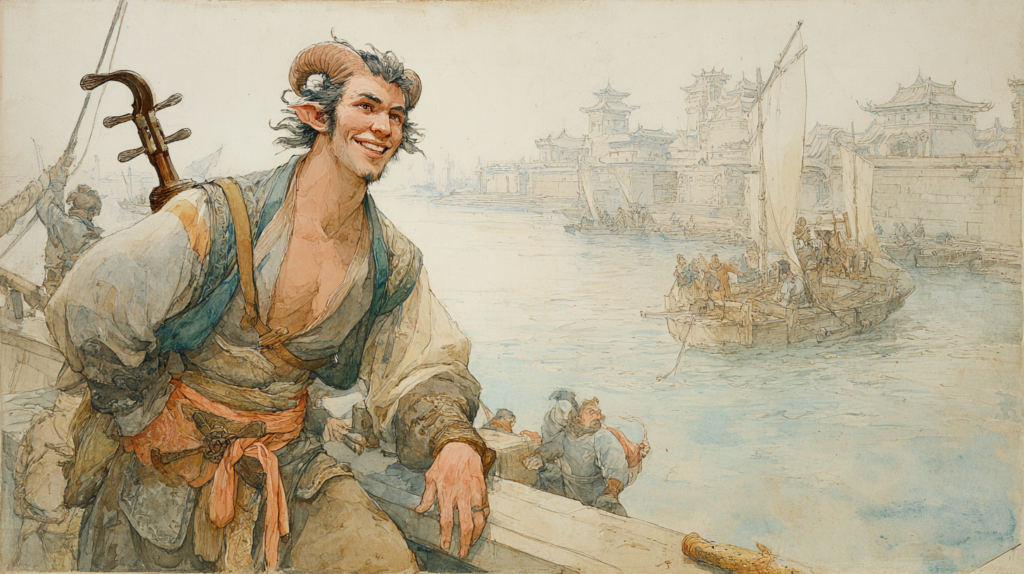
The travelling opera troupes of Elfmyst move between cities on painted wagons, performing at court and in gutters, sometimes on the same night. You came up in one of these, learning to read music on the roads between Junre, Leukish, or some other city. You have gotten quite good with your instrument, and you know how to brighten a room or darken one with ease.
You know that your music not merely sound, it is a form of magic. You have learned to thread your harmonies with threads of power. With a quip you steady a shaking hand, and with a rhythm you sharpen a fighter’s next blow. Some of your kind spend years accumulating lore, becoming something between a scholar and a rumor. Others carry a blade alongside the instrument and are considerably more dangerous than either suggests.
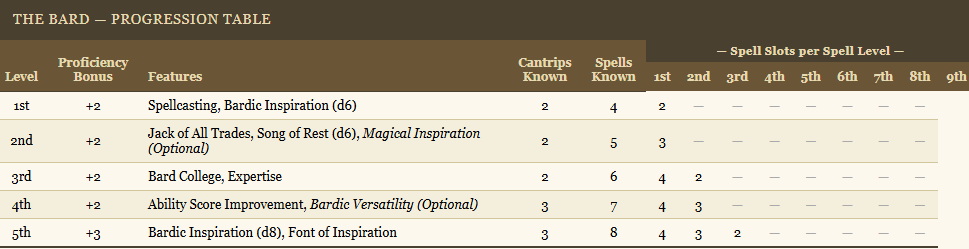
As a bard, you gain the following class features.
Hit Points
Hit Dice: 1d8 per bard level
Hit Points at 1st Level: 8 + your Constitution modifier
Hit Points at Higher Levels: 1d8 (or 5) + your Constitution modifier per bard level after 1stProficiencies
Armor: Light armor
Weapons: Simple weapons, hand crossbows, longswords, rapiers, shortswords
Tools: Three musical instruments of your choice
Saving Throws: Dexterity, Charisma
Skills: Choose any threeEquipment
You start with the following equipment, in addition to the equipment granted by your background:
- (a) a rapier, (b) a longsword, or (c) any simple weapon
- (a) a diplomat’s pack or (b) an entertainer’s pack
- (a) a lute or (b) any other musical instrument
- Leather armor and a dagger
You have learned to untangle and reshape the fabric of reality in harmony with your wishes and music. Your spells are part of your vast repertoire, magic that you can tune to different situations.
Cantrips
You know two cantrips of your choice from the bard spell list. You learn additional bard cantrips of your choice at higher levels, as shown in the Cantrips Known column of the Bard table.
Spell Slots
The Bard table shows how many spell slots you have to cast your spells of 1st level and higher. To cast one of these spells, you must expend a slot of the spell’s level or higher. You regain all expended spell slots when you finish a long rest.
For example, if you know the 1st-level spell cure wounds and have a 1st-level and a 2nd-level spell slot available, you can cast cure wounds using either slot.Spells Known of 1st Level and Higher
You know four 1st-level spells of your choice from the bard spell list.
The Spells Known column of the Bard table shows when you learn more bard spells of your choice. Each of these spells must be of a level for which you have spell slots, as shown on the table. For instance, when you reach 3rd level in this class, you can learn one new spell of 1st or 2nd level.
Additionally, when you gain a level in this class, you can choose one of the bard spells you know and replace it with another spell from the bard spell list, which also must be of a level for which you have spell slots.Spellcasting Ability
Charisma is your spellcasting ability for your bard spells. Your magic comes from the heart and soul you pour into the performance of your music or oration. You use your Charisma whenever a spell refers to your spellcasting ability. In addition, you use your Charisma modifier when setting the saving throw DC for a bard spell you cast and when making an attack roll with one.
Spell save DC = 8 + your proficiency bonus + your Charisma modifier
Spell attack modifier = your proficiency bonus + your Charisma modifier
Ritual Casting
You can cast any bard spell you know as a ritual if that spell has the ritual tag.
Spellcasting Focus
You can use a musical instrument as a spellcasting focus for your bard spells.
You can inspire others through stirring words or music. To do so, you use a bonus action on your turn to choose one creature other than yourself within 60 feet of you who can hear you. That creature gains one Bardic Inspiration die, a d6.
Once within the next 10 minutes, the creature can roll the die and add the number rolled to one ability check, attack roll, or saving throw it makes. The creature can wait until after it rolls the d20 before deciding to use the Bardic Inspiration die, but must decide before the GM says whether the roll succeeds or fails. Once the Bardic Inspiration die is rolled, it is lost. A creature can have only one Bardic Inspiration die at a time.
You can use this feature a number of times equal to your Charisma modifier (a minimum of once). You regain any expended uses when you finish a long rest.
Your Bardic Inspiration die changes when you reach certain levels in this class. The die becomes a d8 at 5th level, a d10 at 10th level, and a d12 at 15th level.
-
Cleric
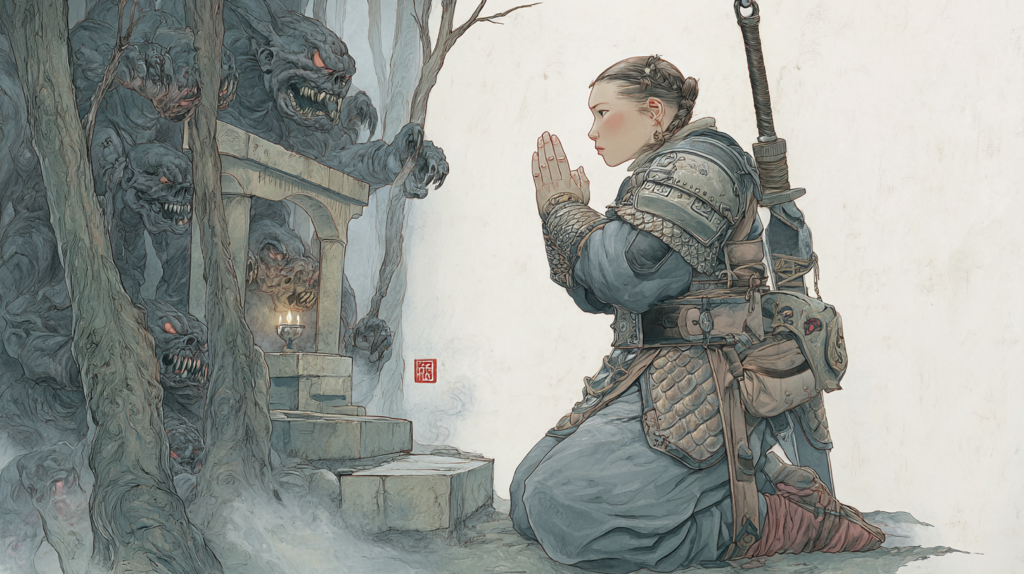
Elfmyst is a world living gods and powerful spirits that take an active role in the world, and you have developed a bond with them. You were a novice to a priest who honored the old ways and kept the shrine incense lit, even in the darkest times. You were taught how to read the old prayer books, speak the prayers to heal the sick, and write the runes on the prayer charms that keep dark creatures and the undead at bay. The world is dangerous, and has a need for people like you to honor the old shrines and tend to the living.
You hold a connection to a god and the powers of Elfmyst that are their domains, but the world is large and the gods are many. As you follow the way of the cleric, you will commune with many gods and learn how to channel their power. You will learn to channel the divine power of the gods of the world to turn back the undead in battle, heal the sick, banish fiends, and strengthen your allies.
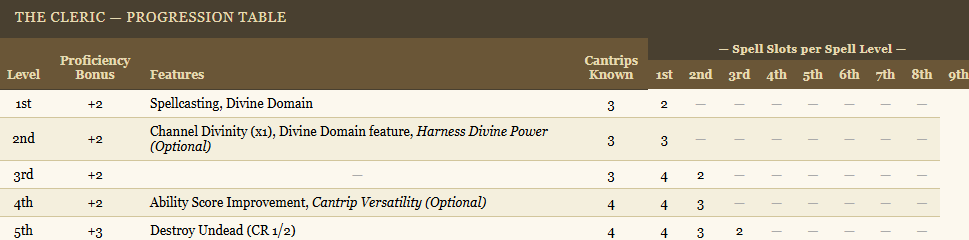
As a cleric, you gain the following class features.
Hit Points
Hit Dice: 1d8 per cleric level
Hit Points at 1st Level: 8 + your Constitution modifier
Hit Points at Higher Levels: 1d8 (or 5) + your Constitution modifier per cleric level after 1stProficiencies
Armor: Light armor, medium armor, shields
Weapons: Simple weapons
Tools: None
Saving Throws: Wisdom, Charisma
Skills: Choose two from History, Insight, Medicine, Persuasion, and ReligionEquipment
You start with the following equipment, in addition to the equipment granted by your background:
- (a) a mace or (b) a warhammer (if proficient)
- (a) scale mail, (b) leather armor, or (c) chain mail (if proficient)
- (a) a light crossbow and 20 bolts or (b) any simple weapon
- (a) a priest’s pack or (b) an explorer’s pack
- A shield and a holy symbol
As a conduit for divine power, you can cast cleric spells.
Cantrips
At 1st level, you know three cantrips of your choice from the cleric spell list. You learn additional cleric cantrips of your choice at higher levels, as shown in the Cantrips Known column of the Cleric table.
Preparing and Casting Spells
The Cleric table shows how many spell slots you have to cast your spells of 1st level and higher. To cast one of these spells, you must expend a slot of the spell’s level or higher. You regain all expended spell slots when you finish a long rest.
You prepare the list of cleric spells that are available for you to cast, choosing from the cleric spell list. When you do so, choose a number of cleric spells equal to your Wisdom modifier + your cleric level (minimum of one spell). The spells must be of a level for which you have spell slots.
For example, if you are a 3rd-level cleric, you have four 1st-level and two 2nd-level spell slots. With a Wisdom of 16, your list of prepared spells can include six spells of 1st or 2nd level, in any combination. If you prepare the 1st-level spell cure wounds, you can cast it using a 1st-level or 2nd-level slot. Casting the spell doesn’t remove it from your list of prepared spells.
You can change your list of prepared spells when you finish a long rest. Preparing a new list of cleric spells requires time spent in prayer and meditation: at least 1 minute per spell level for each spell on your list.Spellcasting Ability
Wisdom is your spellcasting ability for your cleric spells. The power of your spells comes from your devotion to your deity. You use your Wisdom whenever a cleric spell refers to your spellcasting ability. In addition, you use your Wisdom modifier when setting the saving throw DC for a cleric spell you cast and when making an attack roll with one.
Spell save DC = 8 + your proficiency bonus + your Wisdom modifier Spell attack modifier = your proficiency bonus + your Wisdom modifier
Ritual Casting
You can cast a cleric spell as a ritual if that spell has the ritual tag and you have the spell prepared.
Spellcasting
Focus – You can use a holy symbol as a spellcasting focus for your cleric spells.
The Life domain is a portfolio of powers granted to the faithful of gods who are associated with the fragile thread of life in Elfmyst. These gods take an active role in the world through their clerics, empowering them to heal the sick and tend to the wounded. You may follow the teachings of Janziduur, the wandering mendicant who teachs the mending arts and importance of care for the sickly. Alternatively, you may have been honored by Liga, the sun goddess, and wield her healing light to banish sickness. Your deity does call on you from time to time, and the occasional portent or sign is not uncommon for you to encounter.
Life Domain Spells
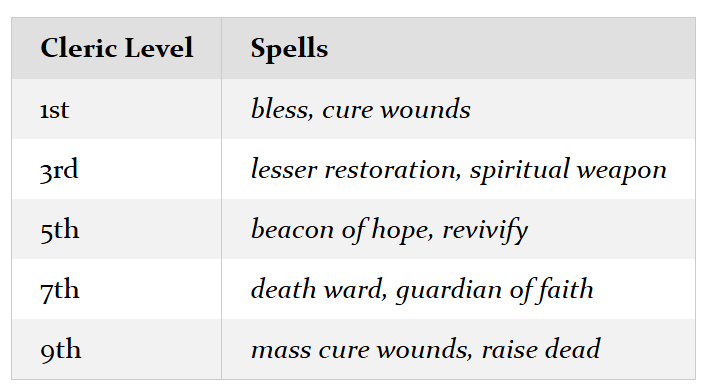
Bonus ProficiencyWhen you choose this domain at 1st level, you gain proficiency with heavy armor.
Disciple of Life
Also starting at 1st level, your healing spells are more effective. Whenever you use a spell of 1st level or higher to restore hit points to a creature, the creature regains additional hit points equal to 2 + the spell’s level.
-
Druid
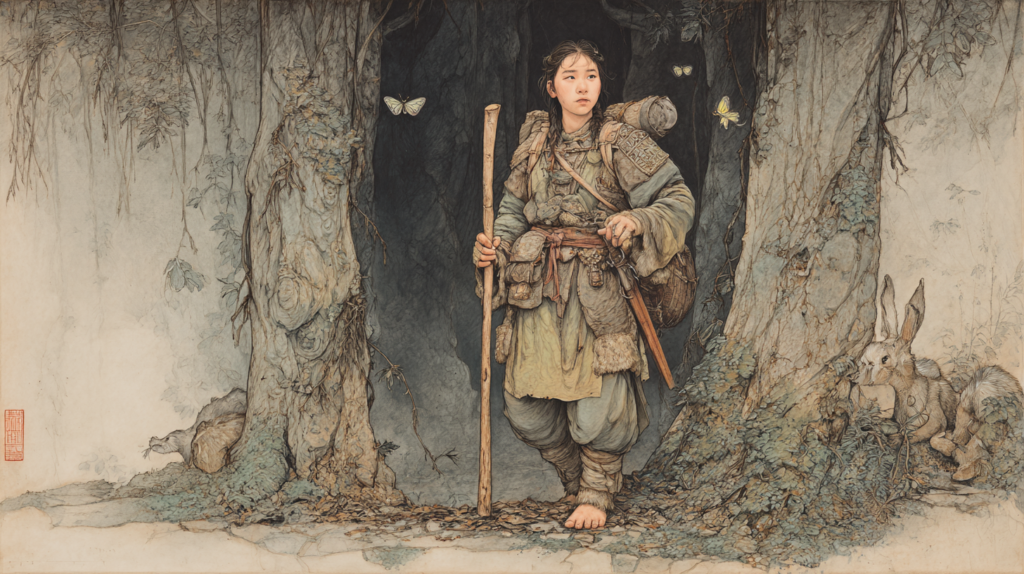
Druids are the keepers and wardens of nature in the lands of Elfmyst. You may follow the teachings of Ehlonna, the great Ki-rin, or learned your abilities from the teachings of the Old Faith. You serve the communities that know you negotiating treaties with creatures of the feywild and slaying abominations that corrupt.
You channel the primal forces of nature, and your spells allow you to command plants and transform into the wild shape of a beast. As you pursue this path, you will learn to channel the primal magics of any land you walk through and some say even stop-aging. You have been sent into the world by a mentor, or on a quest by a spirit. There are ominous rumours that the Green Path is returning to the world, and you intend to stop them.
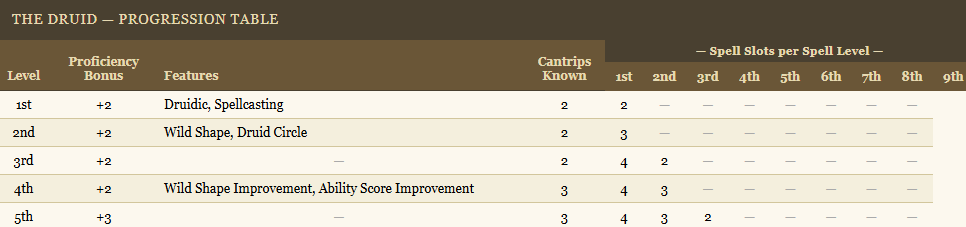
As a druid, you gain the following class features.
Hit Points
Hit Dice: 1d8 per druid level
Hit Points at 1st Level: 8 + your Constitution modifier
Hit Points at Higher Levels: 1d8 (or 5) + your Constitution modifier per druid level after 1stProficiencies
Armor: Light armor, medium armor, shields (druids will not wear armor or use shields made of metal)
Weapons: Clubs, daggers, darts, javelins, maces, quarterstaffs, scimitars, sickles, slings, spears
Tools: Herbalism kit
Saving Throws: Intelligence, Wisdom
Skills: Choose two from Arcana, Animal Handling, Insight, Medicine, Nature, Perception, Religion, and SurvivalEquipment
You start with the following equipment, in addition to the equipment granted by your background:
- (a) a wooden shield or (b) any simple weapon
- (a) a scimitar or (b) any simple melee weapon
- Leather armor, an explorer’s pack, and a druidic focus
You know Druidic, the secret language of druids. You can speak the language and use it to leave hidden messages. You and others who know this language automatically spot such a message. Others spot the message’s presence with a successful DC 15 Wisdom (Perception) check but can’t decipher it without magic.
Drawing on the divine essence of nature itself, you can cast spells to shape that essence to your will.
Cantrips
At 1st level, you know two cantrips of your choice from the druid spell list. You learn additional druid cantrips of your choice at higher levels, as shown in the Cantrips Known column of the Druid table.
Preparing and Casting Spells
The Druid table shows how many spell slots you have to cast your spells of 1st level and higher. To cast one of these druid spells, you must expend a slot of the spell’s level or higher. You regain all expended spell slots when you finish a long rest.
You prepare the list of druid spells that are available for you to cast, choosing from the druid spell list. When you do so, choose a number of druid spells equal to your Wisdom modifier + your druid level (minimum of one spell). The spells must be of a level for which you have spell slots.
For example, if you are a 3rd-level druid, you have four 1st-level and two 2nd-level spell slots. With a Wisdom of 16, your list of prepared spells can include six spells of 1st or 2nd level, in any combination. If you prepare the 1st-level spell cure wounds, you can cast it using a 1st-level or 2nd-level slot. Casting the spell doesn’t remove it from your list of prepared spells.
You can also change your list of prepared spells when you finish a long rest. Preparing a new list of druid spells requires time spent in prayer and meditation: at least 1 minute per spell level for each spell on your list.Spellcasting Ability
Wisdom is your spellcasting ability for your druid spells, since your magic draws upon your devotion and attunement to nature. You use your Wisdom whenever a spell refers to your spellcasting ability. In addition, you use your Wisdom modifier when setting the saving throw DC for a druid spell you cast and when making an attack roll with one.
Spell save DC = 8 + your proficiency bonus + your Wisdom modifier
Spell attack modifier = your proficiency bonus + your Wisdom modifier
Ritual Casting
You can cast a druid spell as a ritual if that spell has the ritual tag and you have the spell prepared.
Spellcasting Focus
You can use a druidic focus (see chapter 5, “Equip- ment”) as a spellcasting focus for your druid spells.
-
Fighter
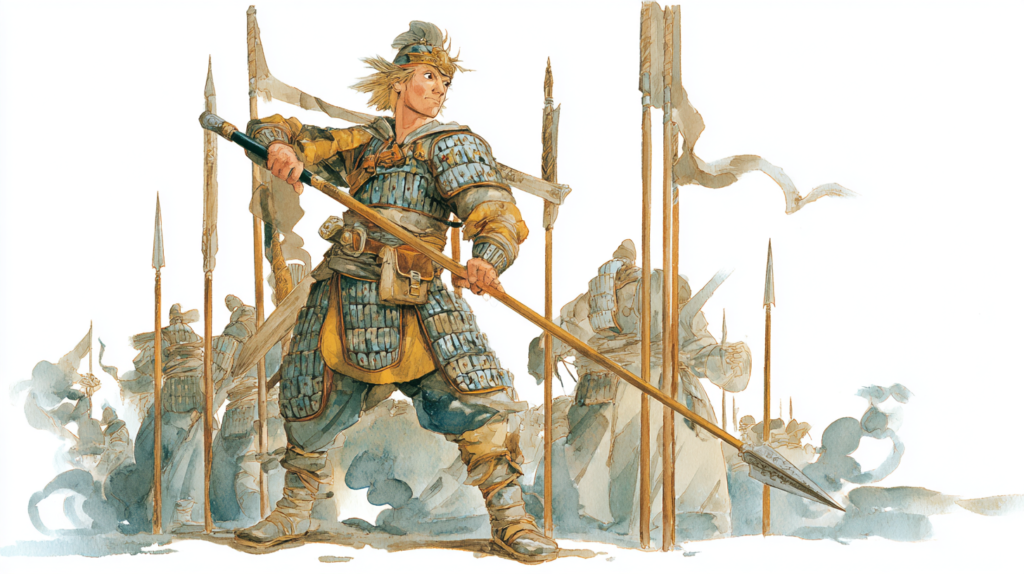
A thousand years of war have taught the peoples of Elfmyst how to master the art of skillful weaponry, and you are one of its students. You may have spent time in the barracks of the Imperial forces as a professional warrior, or in one of the fortresses of the North at a frontier garrison. You have taken to the roads as a wandering mercenary, seeking contracts and companionship as you hone your craft.
As a fighter, you are well-rounded specialist in combat and trained for danger. You have learned a particular fighting style and seek the masters of the world to train you in others. Battle comes naturally to you and you can draw on internal reserves of courage and will to surge in combat and recover much quicker than most. In following this path, you hope to become a champion of something greater. It is up to you to determine what.
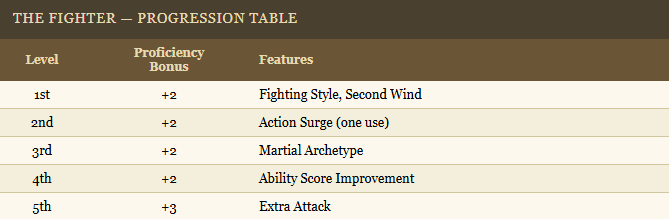
As a fighter, you gain the following class features.
Hit Points
Hit Dice: 1d10 per fighter level
Hit Points at 1st Level: 10 + your Constitution modifier
Hit Points at Higher Levels: 1d10 (or 6) + your Constitution modifier per fighter level after 1stProficiencies
Armor: All armor, shields
Weapons: Simple weapons, martial weapons
Tools: None
Saving Throws: Strength, Constitution
Skills: Choose two skills from Acrobatics, Animal Handling, Athletics, History, Insight, Intimidation, Perception, and SurvivalEquipment
You start with the following equipment, in addition to the equipment granted by your background:
- a dungeoneer’s pack or (b) and explorer’s pack
- chain mail or (b) leather armor, longbow, and 20 arrows
- a martial weapon and a shield or (b) two martial weapons
- a light crossbow and 20 bolts or (b) two handaxes
You adopt a particular style of fighting as your specialty. Choose one of the following options. You can’t take a Fighting Style option more than once, even if you later get to choose again.
Archery
You gain a +2 bonus to attack rolls you make with ranged weapons
Defense
While you are wearing armor, you gain a +1 bonus to AC
Dueling
When you are wielding a melee weapon in one hand and no other weapons, you gain a +2 bonus to damage rolls with that weapon.
Great Weapon Fighting
When you roll a 1 or 2 on a damage die for an attack you make with a melee weapon that you are wielding with two hands, you can reroll the die and must use the new roll, even if the new roll is a 1 or a 2. The weapon must have the two-handed or versatile property for you to gain this benefit.
Protection
When a creature you can see attacks a target other than you that is within 5 feet of you, you can use your reaction to impose disadvantage on the attack roll. You must be wielding a shield.
Two-Weapon Fighting
When you engage in two-weapon fighting, you can add your ability modifier.
You have a limited well of stamina that you can draw on to protect yourself from harm. On your turn, you can use a bonus action to regain hit points equal to 1d10 + your fighter level. Once you use this feature, you must finish a short or long rest before you can use it again.
-
Monk
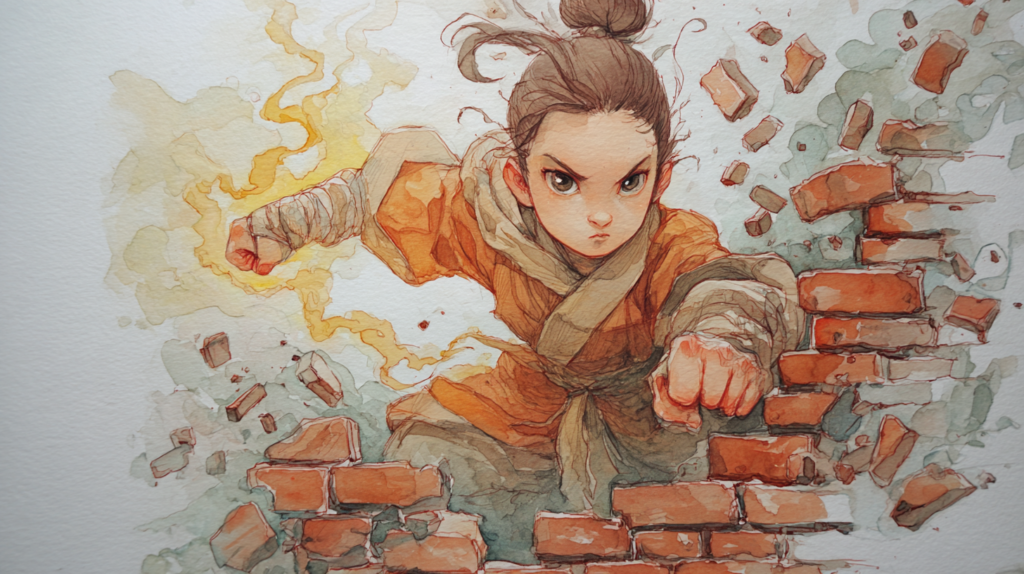
Whether through self-discipline, training, or sheer willpower, you have learned to cultivate the internal force of qi. You had a master, who taught you to split rocks with the forces of your fist. They also taught you that carrying buckets of water needlessly up and down steps and other back-breaking work was “good moral character.” You have left this home, to find your way in the world.
As a monk, you have cultivated the quiet fire within to harden yourself. Striking you is like slicing at someone in full armor, which you have no need for. You have learned a martial art to channel your strength, and your strikes can topple giants. You will learn how to shield your mind and form from all attacks, shatter mountains, run like the wind, and maybe even achieve immortality.
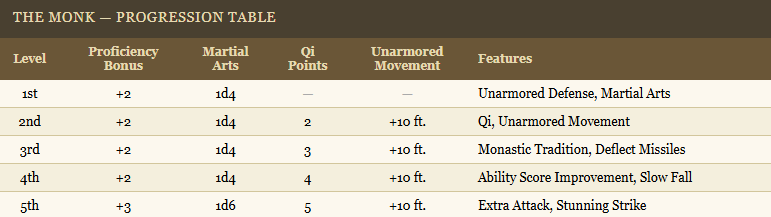
As a monk, you gain the following class features:
Hit Points
Hit Dice: 1d8 per monk level
Hit Points at 1st Level: 8 + your Constitution modifier
Hit Points at Higher Levels: 1d8 (or 5) + your Constitution modifier per monk level after 1stProficiencies
Armor: None
Weapons: Simple weapons, shortswords
Tools: Choose one type of artisan’s tools or one musical instrument
Saving Throws: Strength, Dexterity
Skills: Choose two from Acrobatics, Athletics, History, Insight, Religion, and StealthEquipment
You start with the following equipment, in addition to the equipment granted by your background:
- (a) a shortsword or (b) any simple weapon
- (a) a dungeoneer’s pack or (b) an explorer’s pack
- 10 darts
Beginning at 1st level, while you are wearing no armor and not wielding a shield, your AC equals 10 + your Dexterity modifier + your Wisdom modifier.
At 1st level, your practice of martial arts gives you mastery of combat styles that use unarmed strikes and monk weapons, which are shortswords and any simple melee weapons that don’t have the two-handed or heavy property. You gain the following benefits while you are unarmed or wielding only monk weapons and you aren’t wearing armor or wielding a shield:
- You can use Dexterity instead of Strength for the attack and damage rolls of your unarmed strikes and monk weapons.
- You can roll a d4 in place of the normal damage of your unarmed strike or monk weapon. This die changes as you gain monk levels, as shown in the Martial Arts column of the Monk table.
- When you use the Attack action with an unarmed strike or a monk weapon on your turn, you can make one unarmed strike as a bonus action. For example, if you take the Attack action and attack with a quarterstaff, you can also make an unarmed strike as a bonus action, assuming you haven’t already taken a bonus action this turn.
Certain monasteries use specialized forms of the monk weapons. For example, you might use a club that is two lengths of wood connected by a short chain (called a nunchaku) or a sickle with a shorter, straighter blade (called a kama). Whatever name you use for a monk weapon, you can use the game statistics provided for the weapon.
-
Paladin
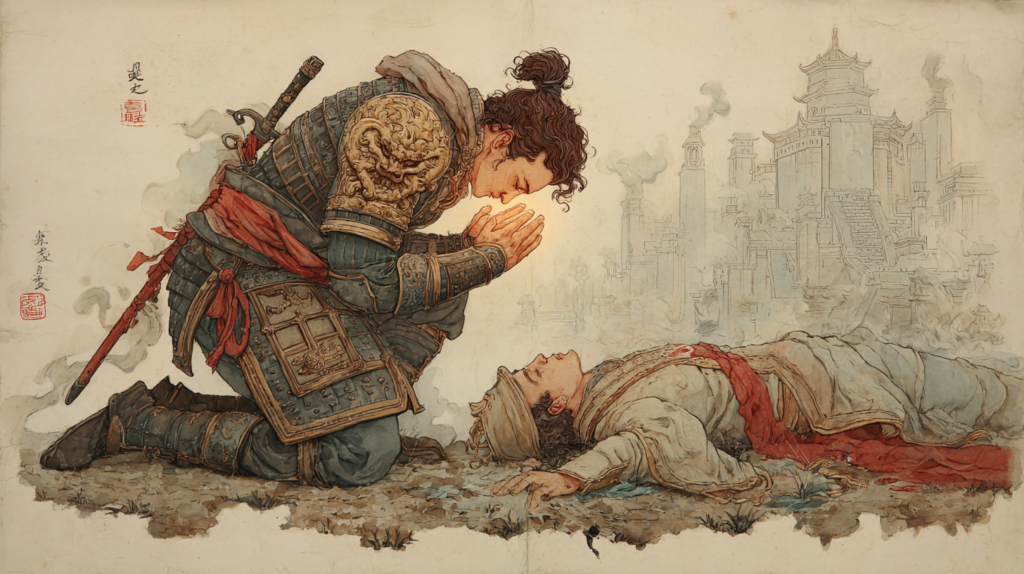
Paladins are called to live a life of righteousness beyond the mundane of most. In Elfmyst, paladins serve as temple guardians, sworn to protect holy places and communities. Their devotion to the gods or the sacred grants them a touch of divine power. You may have trained at a temple of Rao, god of order, or among the crusaders of the Order of the Hart.
As a paladin, you have an innate sense of the spirits and have been trained to hunt the undead. You will learn protective magics to defend yourself and your allies from the dark forces of the world. These abilities do not come without a cost though. You will be expected by many to deal with dark forces when they arise, and much will be asked of you. You are still a novice, and someday hope to be given an opportunity to swear an oath of devotion to the powers of the Heavens.
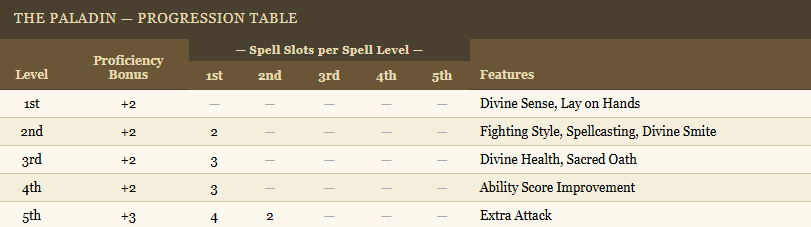
Hit Dice: 1d10 per paladin level
Hit Points at 1st Level: 10 + your Constitution modifier
Hit Points at Higher Levels: 1d10 (or 6) + your Constitution modifier per paladin level after 1stProficiencies
Armor: All armor, shields
Weapons: Simple weapons, martial weapons
Tools: None
Saving Throws: Wisdom, Charisma
Skills: Choose two from Athletics, Insight, Intimidation, Medicine, Persuasion and ReligionEquipment
You start with the following equipment, in addition to the equipment granted by your background:
- (a) a martial weapon and a shield or (b) two martial weapons
- (a) five javelins or (b) any simple melee weapon
- (a) a priest’s pack or (b) an explorer’s pack
- Chain mail and a holy symbol
The presence of strong evil registers on your senses like a noxious odor, and powerful good rings like heavenly music in your ears. As an action, you can open your awareness to detect such forces. Until the end of your next turn, you know the location of any celestial, fiend, or undead within 60 feet of you that is not behind total cover. You know the type (celestial, fiend, or undead) of any being whose presence you sense, but not its identity (the vampire Count Strahd von Zarovich, for instance). Within the same radius, you also detect the presence of any place or object that has been consecrated or desecrated, as with the hallow spell.
You can use this feature a number of times equal to 1 + your Charisma modifier. When you finish a long rest, you regain all expended uses.
Your blessed touch can heal wounds. You have a pool of healing power that replenishes when you take a long rest. With that pool, you can restore a total number of hit points equal to your paladin level × 5.
As an action, you can touch a creature and draw power from the pool to restore a number of hit points to that creature, up to the maximum amount remaining in your pool.Alternatively, you can expend 5 hit points from your pool of healing to cure the target of one disease or neutralize one poison affecting it. You can cure multiple diseases and neutralize multiple poisons with a single use of Lay on Hands, expending hit points separately for each one.
This feature has no effect on undead and constructs.
-
Ranger
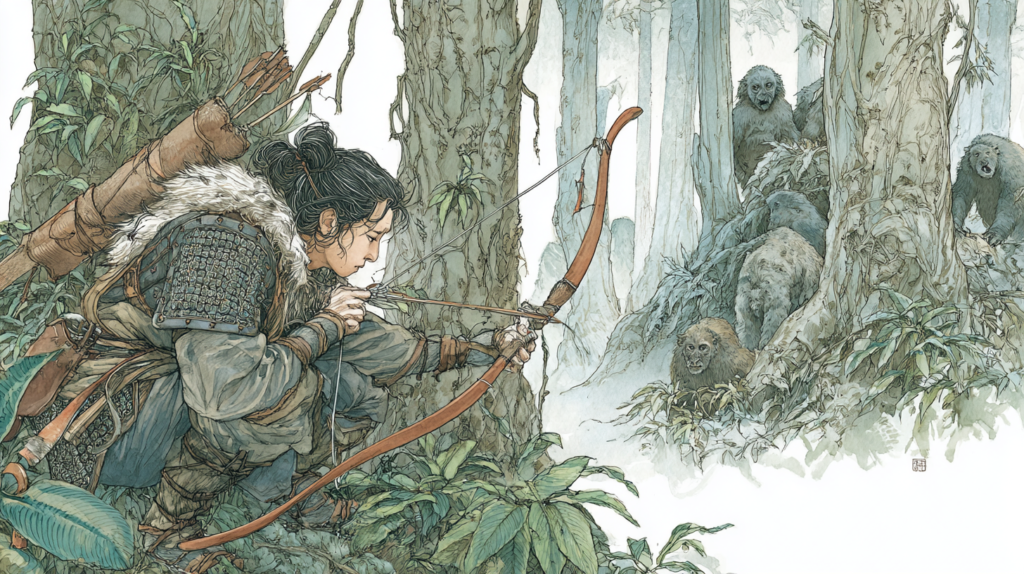
You were raised in a woodland frontier and were taught the way of survival in the ancient forests of Elfmyst, such as the Vesve or Gnarlwood. You may have had a mentor or not, but you learned how to read the tracks of beasts, navigate by the stars, and read the secret messages of the wilds. You tend to prefer your own company, wandering the world, but something in you calls you to protect those who need it from the monsters in the mists.
You are a natural explorer, and your initial training has made you an expert on travelling and surviving in the natural environment you were trained in. As you develop your skills, you will learn to cast simple natural magics, and a cultivate a primeval awareness that attunes you to the land. Some rangers learn how to completely vanish in plain sight, and become legendary hunters of giants and dragons. Rangers congregate in legendary lodges, where they hone their mastery of the bow or beasts.
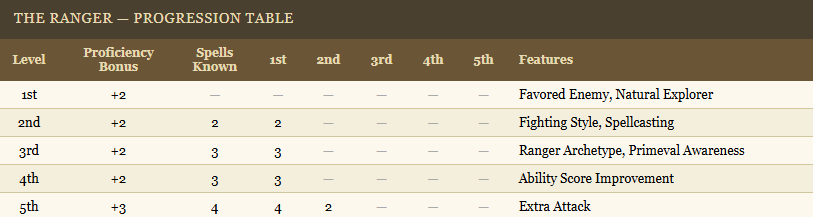
Hit Points
Hit Dice: 1d10 per ranger level
Hit Points at 1st Level: 10 + your Constitution modifier
Hit Points at Higher Levels: 1d10 (or 6) + your Constitution modifier per ranger level after 1stProficiencies
Armor: Light armor, medium armor, shields
Weapons: Simple weapons, martial weapons
Tools: None
Saving Throws: Strength, Dexterity
Skills: Choose three from Animal Handling, Athletics, Insight, Investigation, Nature, Perception, Stealth, and SurvivalEquipment
You start with the following equipment, in addition to the equipment granted by your background:
- (a) scale mail or (b) leather armor
- (a) two shortswords or (b) two simple melee weapons
- (a) a dungeoneer’s pack or (b) an explorer’s pack
- A longbow and a quiver of 20 arrows
Beginning at 1st level, you have significant experience studying, tracking, hunting, and even talking to a certain type of enemy.
Choose a type of favored enemy:- Aberrations
- Beasts
- Celestials
- Constructs
- Dragons
- Elementals
- Fey
- Giants
- Monstrosities
- Oozes
- Plants
- Undead
Additionally, you can select two ancestries as favored enemies from the following list:
- Dragonborn
- Dwarves
- Elves & Half-Elves
- Gnomes
- Goblinoids (Goblins, Hobgoblins, Bugbears, Dromar, and Orcs)
- Halflings
- Humans
- Tieflings
You have advantage on Wisdom (Survival) checks to track your favored enemies, as well as on Intelligence checks to recall information about them.
When you gain this feature, you also learn one language of your choice that is spoken by your favored enemies, if they speak one at all.
You choose one additional favored enemy, as well as an associated language, at 6th and 14th level. As you gain levels, your choices should reflect the types of monsters you have encountered on your adventures.
You are particularly familiar with one type of natural environment and are adept at traveling and surviving in such regions. Choose one type of favored terrain:
- Arctic
- Coast
- Desert
- Forest
- Grassland
- Mountain
- Swamp
When you make an Intelligence or Wisdom check related to your favored terrain, your proficiency bonus is doubled if you are using a skill that you’re proficient in.
While traveling for an hour or more in your favored terrain, you gain the following benefits:
- Difficult terrain doesn’t slow your group’s travel.
- Your group can’t become lost except by magical means.
- Even when you are engaged in another activity while traveling (such as foraging, navigating, or tracking), you remain alert to danger.
- If you are traveling alone, you can move stealthily at a normal pace.
- When you forage, you find twice as much food as you normally would.
- While tracking other creatures, you also learn their exact number, their sizes, and how long ago they passed through the area.
You choose additional favored terrain types at 6th and 10th level.
-
Rogue

You know what you are. Cities like Greyhawk run on information, favors, and picking pockets, all the way up to the nobles of Hightown. You were trained how to pick pockets in the Bazaar, run the rooves of the Slums, and treat a locked door like a personal invitation. The legendary Thieves’ Guild is no more, despite the drunken ramblings of the smelly criminals you associate with. You intend to change that.
Rogues are known for their skill and precision, living shady lives on the edges of the law. You are trained in weapons the give you the finesse to land sneak attacks, and know the Thieves’ Cant, a secret language of outlaw professionals. As you follow the path of the rogue, you will learn to dodge your foes with uncanny speed and even unlock the spellcraft of powerful magic items. You will need to find a mentor to teach you these things.
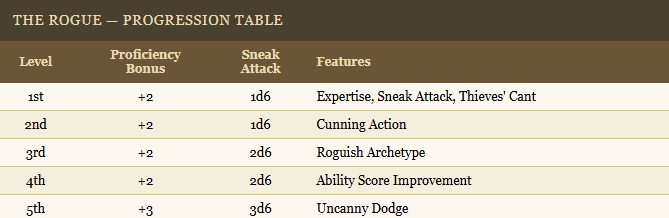
As a rogue, you gain the following class features.
Hit Points
Hit Dice: 1d8 per rogue level
Hit Points at 1st Level: 8 + your Constitution modifier
Hit Points at Higher Levels: 1d8 (or 5) + your Constitution modifier per rogue level after 1stProficiencies
Armor: Light armor
Weapons: Simple weapons, hand crossbows, longswords, rapiers, shortswords
Tools: Thieves’ tools
Saving Throws: Dexterity, Intelligence
Skills: Choose four from Acrobatics, Athletics, Deception, Insight, Intimidation, Investigation, Perception, Performance, Persuasion, Sleight of Hand, and StealthEquipment
You start with the following equipment, in addition to the equipment granted by your background:
(a) Leather armor, two daggers, and thieves’ tools
(a) a rapier or (b) a shortsword
(a) a shortbow and quiver of 20 arrows or (b) a shortsword
(a) a burglar’s pack, (b) a dungeoneer’s pack, or (c) an explorer’s pack
At 1st level, choose two of your skill proficiencies, or one of your skill proficiencies and your proficiency with thieves’ tools. Your proficiency bonus is doubled for any ability check you make that uses either of the chosen proficiencies.
At 6th level, you can choose two more of your proficiencies (in skills or with thieves’ tools) to gain this benefit.
Beginning at 1st level, you know how to strike subtly and exploit a foe’s distraction. Once per turn, you can deal an extra 1d6 damage to one creature you hit with an attack if you have advantage on the attack roll. The attack must use a finesse or a ranged weapon.
You don’t need advantage on the attack roll if another enemy of the target is within 5 feet of it, that enemy isn’t incapacitated, and you don’t have disadvantage on the attack roll.
The amount of the extra damage increases as you gain levels in this class, as shown in the Sneak Attack column of the Rogue table.
During your rogue training you learned thieves’ cant, a secret mix of dialect, jargon, and code that allows you to hide messages in seemingly normal conversation. Only another creature that knows thieves’ cant understands such messages. It takes four times longer to convey such a message than it does to speak the same idea plainly.
In addition, you understand a set of secret signs and symbols used to convey short, simple messages, such as whether an area is dangerous or the territory of a thieves’ guild, whether loot is nearby, or whether the people in an area are easy marks or will provide a safe house for thieves on the run.
-
Sorcerer
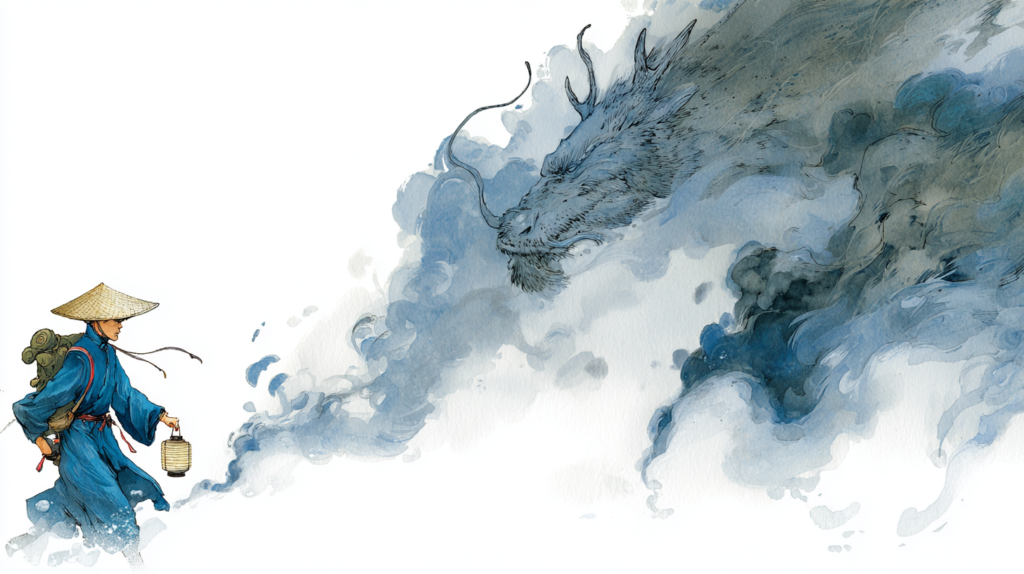
Deep in the secluded communities of the Mountains of Crystal and Mist, dragons dwell among ancient wellsprings of magic. Your ancestors have served them for generations, and it is said that even their blood is mingled with those raw magic of these creatures. Those born with natural connection to the weave of magic are called sorcerers, and you are rare indeed.
You carry within you the blood of dragons and can cast magic naturally. Your spells are more limited than those trained magicians of the courts and magical universities, but you are able to weave your spells in ways others cannot, called metamagic. As you grow in strength, your draconic legacy will manifest in marvellous ways. Why you left the safety of your village is up to you. Maybe you seek a dragon to teach you how to wield this legacy, maybe you just seek adventure.
As a sorcerer, you gain the following class features.
Hit Points
Hit Dice: 1d6 per sorcerer level
Hit Points at 1st Level: 6 + your Constitution modifier
Hit Points at Higher Levels: 1d6 (or 4) + your Constitution modifier per sorcerer level after 1stProficiencies
Armor: None
Weapons: Daggers, darts, slings, quarterstaffs, light crossbows
Tools: None
Saving Throws: Constitution, Charisma
Skills: Choose two from Arcana, Deception, Insight, Intimidation, Persuasion, and ReligionEquipment
You start with the following equipment, in addition to the equipment granted by your background:
- (a) a light crossbow and 20 bolts or (b) any simple weapon
- (a) a component pouch or (b) an arcane focus
- (a) a dungeoneer’s pack or (b) an explorer’s pack
- Two daggers
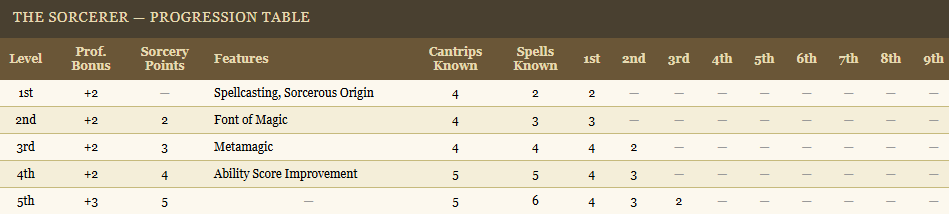
Spells Known of 1st Level and HigherYou know two 1st-level spells of your choice from the sorcerer spell list.
The Spells Known column of the Sorcerer table shows when you learn more sorcerer spells of your choice. Each of these spells must be of a level for which you have spell slots. For instance, when you reach 3rd level in this class, you can learn one new spell of 1st or 2nd level.
Additionally, when you gain a level in this class, you can choose one of the sorcerer spells you know and replace it with another spell from the sorcerer spell list, which also must be of a level for which you have spell slots.Spellcasting Ability
Charisma is your spellcasting ability for your sorcerer spells, since the power of your magic relies on your ability to project your will into the world. You use your Charisma whenever a spell refers to your spellcasting ability. In addition, you use your Charisma modifier when setting the saving throw DC for a sorcerer spell you cast and when making an attack roll with one.
Spell save DC = 8 + your proficiency bonus + your Charisma modifier
Spell attack modifier = your proficiency bonus + your Charisma modifier
Spellcasting Focus
You can use an arcane focus as a spellcasting focus for your sorcerer spells.
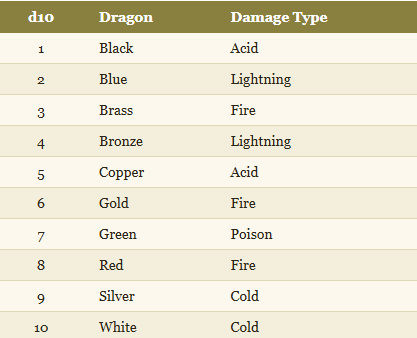
Long ago, an ancestor of yours was taken as a dragon’s mate or in a misty mountain vale you were blessed by a piece of a dragon’s power. This origin grants you features at 1st level and again at 6th, 14th, and 18th level.
Roll 1d10 on the table below to select your draconic ancestry:
Tongue of the Dragons
You can naturally speak, read, and write Draconic. Additionally, whenever you make a Charisma check when interacting with dragons, your proficiency bonus is doubled if it applies to the check.
Draconic Resilience
As magic flows through your body, it causes physical traits of your dragon ancestors to emerge. At 1st level, your hit point maximum increases by 1 and increases by 1 again whenever you gain a level in this class.
Additionally, parts of your skin are covered by a thin sheen of dragon-like scales. When you aren’t wearing armor, your AC equals 13 + your Dexterity modifier.
-
Warlock
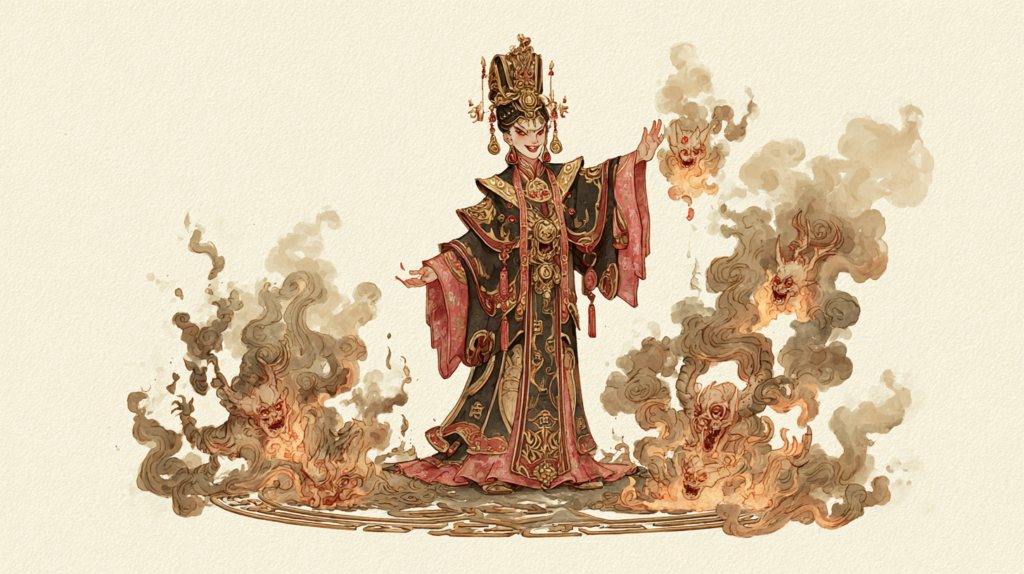
For centuries after the Twin Cataclysms ended the world a thousand years ago, magic was all but forgotten. The survivors of the apocalypse wrought by the Suel mage-lords and Baklunish artificer-kings left the craft of arcane spellwork with a deep air of suspicion. Thus, people looked to other sources of ways to sculpt the world. Those who made pacts with secretive, dark Powers are called warlocks and you are one of them.
You made a pact with one of the dark Powers of the Nine Hells. Through your infernal pact, you are able to access a well of infernal magic. Your Patron will teach you dark invocations and grant you boon wishes, but all power eventually has its price. You are free to travel the world, pursuing your own agendas, but your Patron will request service of you from time to time. It has been hinted that refusal to accomplish these tasks or neglecting them as a priority will bring consequences. You have not yet made that decision.
As a warlock, you gain the following class features.
Hit Points
Hit Dice: 1d8 per warlock level
Hit Points at 1st Level: 8 + your Constitution modifier
Hit Points at Higher Levels: 1d8 (or 5) + your Constitution modifier per warlock level after 1stProficiencies
Armor: Light armor
Weapons: Simple weapons
Tools: None
Saving Throws: Wisdom, Charisma
Skills: Choose two from Arcana, Deception, History, Intimidation, Investigation, Nature, and ReligionEquipment
You start with the following equipment, in addition to the equipment granted by your background: * (a) a light crossbow and 20 bolts or (b) any simple weapon * (a) a component pouch or (b) an arcane focus * (a) a scholar’s pack or (b) a dungeoneer’s pack * Leather armor, any simple weapon, and two daggers
Your arcane research and the magic bestowed on you by your patron have given you facility with spells.
Cantrips
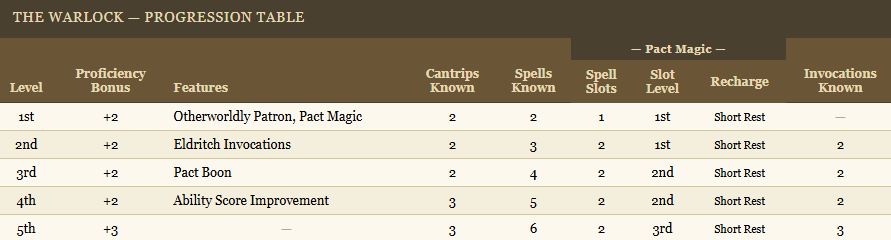
You know two cantrips of your choice from the warlock spell list. You learn additional warlock cantrips of your choice at higher levels, as shown in the Cantrips Known column of the Warlock table.
Spell Slots
The Warlock table shows how many spell slots you have. The table also shows what the level of those slots is; all of your spell slots are the same level. To cast one of your warlock spells of 1st level or higher, you must expend a spell slot. You regain all expended spell slots when you finish a short or long rest.
For example, when you are 5th level, you have two 3rd-level spell slots. To cast the 1st-level spell thunderwave, you must spend one of those slots, and you cast it as a 3rd-level spell.Spells Known of 1st Level and Higher
At 1st level, you know two 1st-level spells of your choice from the warlock spell list.
The Spells Known column of the Warlock table shows when you learn more warlock spells of your choice of 1st level and higher. A spell you choose must be of a level no higher than what’s shown in the table’s Slot Level column for your level. When you reach 6th level, for example, you learn a new warlock spell, which can be 1st, 2nd, or 3rd level.
Additionally, when you gain a level in this class, you can choose one of the warlock spells you know and replace it with another spell from the warlock spell list, which also must be of a level for which you have spell slots.
Spellcasting Ability
Charisma is your spellcasting ability for your warlock spells, so you use your Charisma whenever a spell refers to your spellcasting ability. In addition, you use your Charisma modifier when setting the saving throw DC for a warlock spell you cast and when making an attack roll with one.
Spell save DC = 8 + your proficiency bonus + your Charisma modifier
Spell attack modifier = your proficiency bonus + your Charisma modifier
Spellcasting Focus
You can use an arcane focus as a spellcasting focus for your warlock spells.
At 1st level, you have struck a bargain with an otherworldly Power, the Fiend. Your choice grants you features at 1st level and again at 6th, 10th, and 14th level. Roll a d10 to determine your Patron:
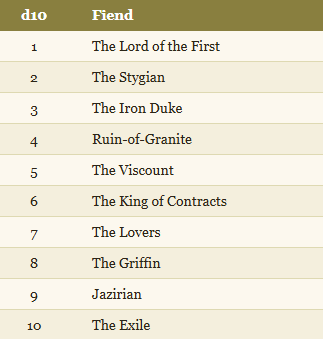
Expanded Spell List
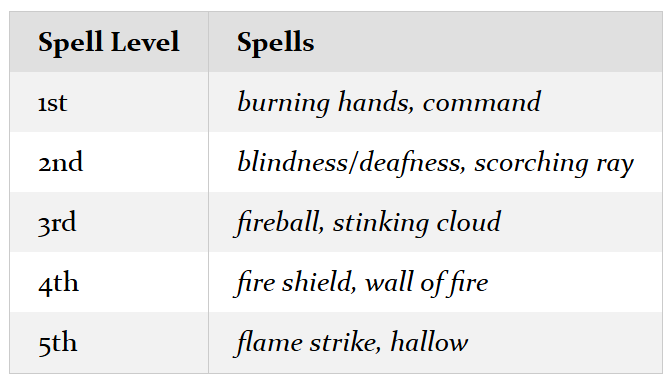
The Fiend lets you choose from an expanded list of spells when you learn a warlock spell. The following spells are added to the warlock spell list for you.
Dark One’s Blessing
Starting at 1st level, when you reduce a hostile creature to 0 hit points, you gain temporary hit points equal to your Charisma modifier + your warlock level (minimum of 1).
-
Wizard
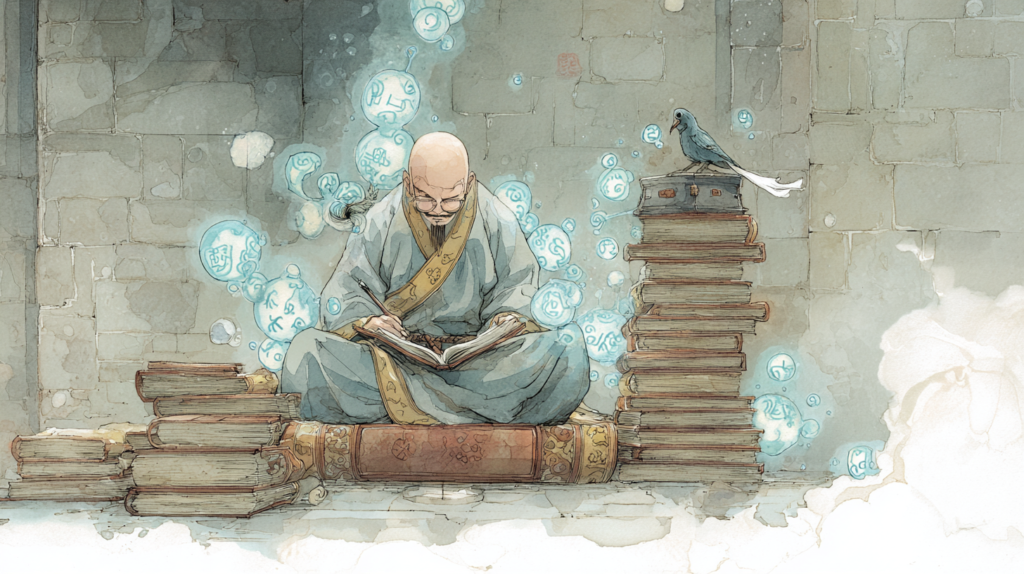
A millenium ago, the great empires of the West ended the world in a magical conflagration, and for a long, dark age, people mistrusted arcane magic. In the past few centuries, as these memories dulled and became legend, some brave few have taken up study of the mysteries of the weave. You are one such student, part of a new generation delving the secrets of Elfmyst.
In the study of your craft, you have found yourself in the role of student at the University of Magical Arts in Greyhawk. There you will focus on an arcane tradition, learning how to conjure arcane wards, divine portents, and sculpt reality to your desires. As a wizard, you are licensed to practice magic in these lands. Most of them.
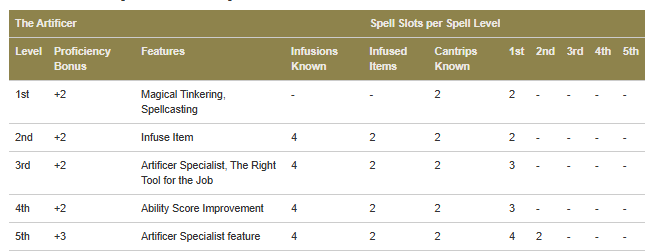
As a wizard, you gain the following class features.
Hit Points
Hit Dice: 1d6 per wizard level
Hit Points at 1st Level: 6 + your Constitution modifier
Hit Points at Higher Levels: 1d6 (or 4) + your Constitution modifier per wizard level after 1stProficiencies
Armor: None
Weapons: Daggers, darts, slings, quarterstaffs, light crossbows
Tools: None
Saving Throws: Intelligence, Wisdom
Skills: Choose two from Arcana, History, Insight, Investigation, Medicine, and ReligionEquipment
You start with the following equipment, in addition to the equipment granted by your background:
- (a) a quarterstaff or (b) a dagger
- (a) a component pouch or (b) an arcane focus
- (a) a scholar’s pack or (b) an explorer’s pack
- A spellbook
As a student of arcane magic, you have a spellbook containing spells that show the first glimmerings of your true power.
Cantrips
At 1st level, you know three cantrips of your choice from the wizard spell list. You learn additional wizard cantrips of your choice at higher levels, as shown in the Cantrips Known column of the Wizard table.
Spellbook
At 1st level, you have a spellbook containing six 1st- level wizard spells of your choice. Your spellbook is the repository of the wizard spells you know, except your cantrips, which are fixed in your mind.
Preparing and Casting Spells
The Wizard table shows how many spell slots you have to cast your spells of 1st level and higher. To cast one of these spells, you must expend a slot of the spell’s level or higher. You regain all expended spell slots when you finish a long rest.
You prepare the list of wizard spells that are available for you to cast. To do so, choose a number of wizard spells from your spellbook equal to your Intelligence modifier + your wizard level (minimum of one spell). The spells must be of a level for which you have spell slots.For example, if you’re a 3rd-level wizard, you have four 1st-level and two 2nd-level spell slots. With an Intelligence of 16, your list of prepared spells can include six spells of 1st or 2nd level, in any combination, chosen from your spellbook. If you prepare the 1st-level spell magic missile, you can cast it using a 1st-level or a 2nd-level slot. Casting the spell doesn’t remove it from your list of prepared spells.
You can change your list of prepared spells when you finish a long rest. Preparing a new list of wizard spells requires time spent studying your spellbook and memorizing the incantations and gestures you must make to cast the spell: at least 1 minute per spell level for each spell on your list.
Spellcasting Ability
Intelligence is your spellcasting ability for your wizard spells, since you learn your spells through dedicated study and memorization. You use your Intelligence whenever a spell refers to your spellcasting ability. In addition, you use your Intelligence modifier when setting the saving throw DC for a wizard spell you cast and when making an attack roll with one.
Spell save DC = 8 + your proficiency bonus + your Intelligence modifier
Spell attack modifier = your proficiency bonus + your Intelligence modifier
Ritual Casting
You can cast a wizard spell as a ritual if that spell has the ritual tag and you have the spell in your spellbook. You don’t need to have the spell prepared.
Spellcasting Focus
You can use an arcane focus as a spellcasting focus for your wizard spells.
Learning Spells of 1st Level and Higher
Each time you gain a wizard level, you can add two wizard spells of your choice to your spellbook for free. Each of these spells must be of a level for which you have spell slots, as shown on the Wizard table. On your adventures, you might find other spells that you can add to your spellbook.
You have learned to regain some of your magical energy by studying your spellbook. Once per day when you finish a short rest, you can choose expended spell slots to recover. The spell slots can have a combined level that is equal to or less than half your wizard level (rounded up), and none of the slots can be 6th level or higher.
For example, if you’re a 4th-level wizard, you can recover up to two levels worth of spell slots. You can recover either a 2nd-level spell slot or two 1st-level spell slots.